Discover is laser hair removal permanent: What it means for you
EVERYDAYBy Linksfield Laser Clinic
So, is laser hair removal permanent? It’s the number one question we get, and the honest answer is this: it offers permanent hair reduction, not total and forever removal. After your full course of treatments, you can expect a massive 80-90% reduction in unwanted hair. That means long-lasting smoothness that other methods simply can't touch.
The Truth About Permanent Laser Hair Removal
When people ask if it's permanent, what they're really hoping for is a lifetime free from the hassle of shaving or waxing. While the results are incredibly long-lasting, the term permanent hair reduction is a much more accurate and transparent way to describe it.
Think of your skin as a garden where unwanted hair follicles are like weeds. A full course of laser treatments is like bringing in a professional landscaping team. They don't just cut the weeds down; they expertly remove the vast majority of them and, most importantly, damage the roots so they can't grow back. This leaves your "garden" looking clear, smooth, and beautiful for years.
But just like any garden, a few stubborn or new weeds might occasionally pop up over time, often due to things like hormonal changes. These are easily dealt with in quick, infrequent maintenance sessions. The original, dense growth is gone for good. That's the real magic of permanent reduction—a dramatic and lasting change.
Why It Is Still the Best Long-Term Solution
That significant reduction is precisely why professional laser hair removal is still the gold standard. For our clients in Johannesburg looking for smoother skin, the results are seriously impressive. In fact, a recent South African study confirmed that professional diode lasers can achieve an 85-88% hair reduction after a full series of treatments, solidifying its status as a near-permanent solution. This is miles ahead of what any at-home device could ever promise. You can check out the full study on diode laser effectiveness on PubMed.
To really put things into perspective, let's see how it stacks up against the usual suspects.
Hair Removal Methods Compared: Longevity and Effort
When you're tired of the endless cycle of temporary hair removal, understanding the long-term payoff of different methods is key. This table breaks down what you can realistically expect.
Method
Average Duration of Results
Long-Term Outcome
Typical Effort Required
Shaving
1–3 days
Hair grows back coarse and quickly
Daily or every few days
Waxing
3–6 weeks
Hair regrows; risk of painful ingrowns
Monthly appointments; messy at-home kits
Depilatory Creams
3–7 days
Hair dissolves, then regrows
Weekly; chemical smell and potential irritation
Laser Hair Removal
Years
Permanent hair reduction
A series of initial sessions, then rare touch-ups
As you can see, while other methods are just a temporary fix, only our professional laser hair removal treatments deliver a lasting solution that fundamentally changes how your hair grows. It's an investment in a future with significantly less hair and a whole lot more freedom.
How Laser Energy Actually Gets the Job Done
To really get why laser hair removal leads to permanent reduction, you have to look past the "zapping" and into the clever science at play. This isn't just about removing the hair you can see; it's about systematically disabling the factory that makes it—the hair follicle.
The whole process hinges on a principle called selective photothermolysis. It's a mouthful, but the concept is beautifully simple. "Photo" means light, "thermo" means heat, and "lysis" means destruction. In short, the laser uses light to deliver a targeted burst of heat to destroy a very specific thing.
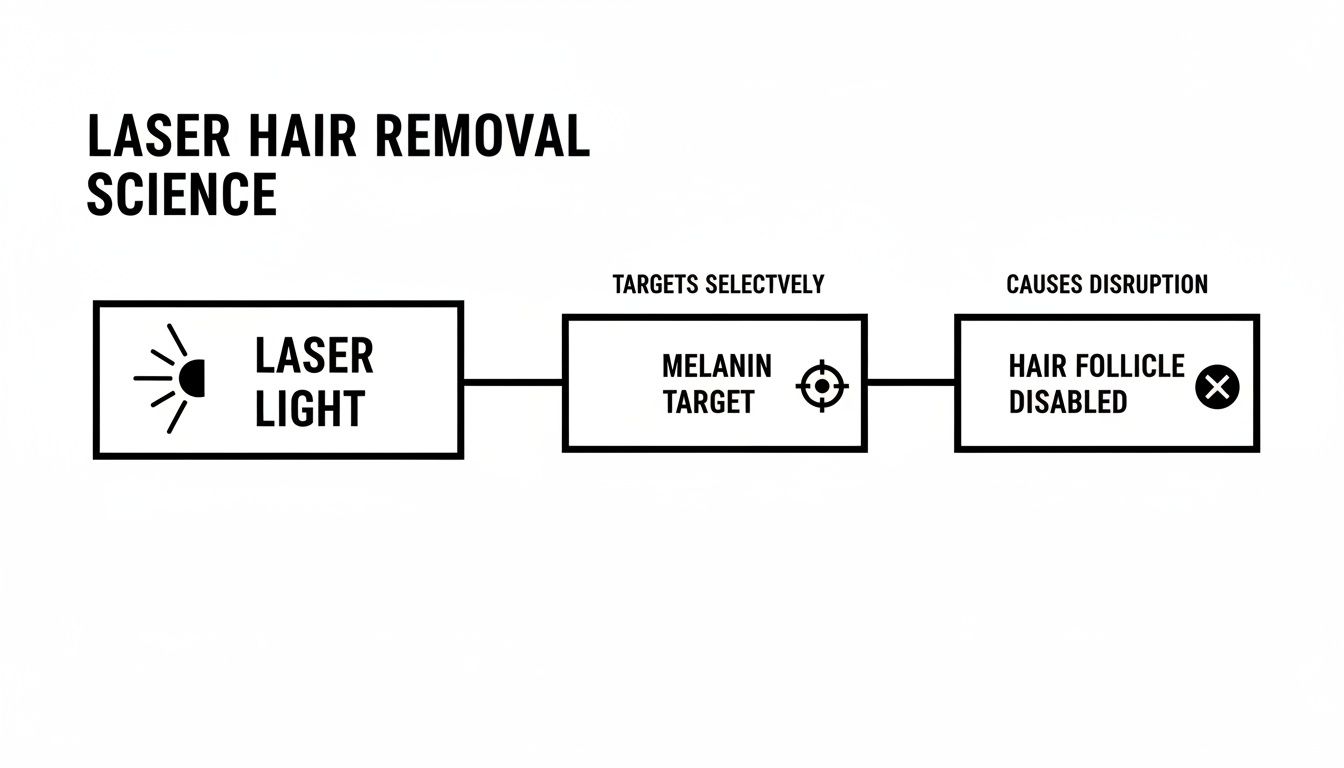
That specific thing is melanin, the pigment that gives your hair its colour. Think of the laser's energy like a smart bomb programmed to find only melanin. When the laser passes over your skin, its focused beam is instantly soaked up by the dark pigment in the hair. This is exactly why the treatment is most effective when there's a good contrast between dark hair and lighter skin—the laser can find its target without any confusion.
The light energy zips down the hair shaft, using it like a wire, until it reaches the root. The moment it gets to the base of the follicle, that light energy converts into intense heat. It’s just enough heat to damage the key structures responsible for growing a new hair, effectively shutting the factory down without harming the surrounding skin.
Timing is Everything: The Hair Growth Cycle
This targeted attack is incredibly precise, but there's a catch. For the laser's energy to hit its mark, the hair has to be in the right phase of its growth cycle. Every single hair on your body goes through three stages, and being in the right one is non-negotiable for success.
Not all your hairs are in the same stage at the same time, which is the number one reason why you can't get away with just one session. Multiple treatments aren't an upsell; they're essential.
Anagen (The Growth Phase): This is the sweet spot. In this active phase, the hair is physically connected to the follicle's base (the papilla), which acts as its power source. This connection is the perfect pathway for the laser's heat to travel down and destroy the follicle's growth centre. This is the only phase where laser hair removal works.
Catagen (The Transitional Phase): This is a brief in-between stage where the hair separates from the papilla and stops growing. Because that physical link is broken, the laser's heat has no way to reach the follicle and can't do its job.
Telogen (The Resting Phase): Finally, the old hair is just resting in the follicle while a new one starts to form underneath. The old hair will eventually fall out, but during this time, the follicle is dormant and won't respond to the laser at all.
At any given moment, only about 10-20% of your hair is in that perfect anagen phase. That means each laser session can only successfully target that small fraction.
The whole point of a laser hair removal plan is to systematically catch more and more hair in the anagen phase over several months. By scheduling sessions four to six weeks apart, we ensure we’re ready for the next wave of hair as it enters its growth stage, progressively disabling more follicles with every visit.
Why Multiple Sessions Are Non-Negotiable
Think of it like trying to weed a garden, but you can only pull the weeds that have a yellow flower on them. You'd have to come back every few weeks to catch the next batch as they bloom. Laser hair removal works exactly the same way.
Each treatment builds on the one before it, chipping away at the total number of active, hair-producing follicles. Over a full course of treatments, we can strategically target the vast majority of your hairs when they're in their vulnerable anagen phase. This patient, phased approach is the secret to achieving the significant, long-lasting smoothness that defines permanent hair reduction.
Factors That Influence Your Long-Term Results
Getting that incredible 80-90% permanent hair reduction isn't a simple, one-size-fits-all deal. Think of your final results as a unique story written by your own body, shaped by a few key personal factors. Understanding these variables is crucial for setting realistic expectations and shows exactly why a professional assessment is non-negotiable for creating a treatment plan that actually works for you.
It's a bit like a tailor creating a bespoke suit—they have to consider the specific fabric and cut to get a perfect fit. In the same way, an expert laser technician needs to analyse your individual characteristics to deliver the best possible outcome.
The Contrast Between Skin Tone and Hair Colour
At its core, laser hair removal works on a simple principle: contrast. The laser's energy is designed to be absorbed by the dark melanin in your hair follicles, so for it to work its magic, it needs a clear target.
This is why, historically, the ideal combination has always been dark, coarse hair on fair skin. This high-contrast scenario makes it incredibly easy for the laser to zap the hair follicle without affecting the surrounding skin, leading to powerful and efficient results.
But technology has come a very long way. Modern lasers, like the advanced systems we use at Linksfield Laser Clinic, have incredibly precise settings. This means we can now safely and effectively treat a much wider spectrum of skin tones, including darker complexions that were once considered too tricky to manage. The secret lies in using the right machine for your specific profile.
The Role of Hormones in Hair Growth
Your body's hormonal landscape plays a massive role in hair growth, and it can sometimes be the culprit behind new hair popping up years after your initial treatments. It’s important to get this straight: laser hair removal disables the active follicles we treat during your sessions, but it can’t stop new ones from being activated later in life.
Hormonal shifts can awaken dormant follicles that weren't even on our radar during your treatment course. Common triggers include:
Major Life Events: Things like pregnancy or menopause can cause significant hormonal changes that might stimulate new hair growth.
Medical Conditions: Conditions such as Polycystic Ovary Syndrome (PCOS) are known to cause the growth of new, unwanted hair on the face and body.
Medication: Certain medications can also throw your body's hormonal balance off-kilter and affect hair growth patterns.
This doesn't mean your original treatment failed! It just means your body has changed. A quick maintenance session once or twice a year is usually all it takes to manage this new growth and keep your skin beautifully smooth.
Key Takeaway: Permanent hair reduction targets and destroys existing, active hair follicles. It cannot, however, prevent your body's natural hormonal changes from activating entirely new follicles in the future.
This infographic breaks down the basic science, from the laser's light targeting melanin to the follicle being disabled.
This visual journey shows how that focused energy gets absorbed by the hair's pigment, effectively shutting down the follicle right at its root.
Technician Skill and Technology Quality
Finally, and this might be the most critical point, the expertise of your technician and the quality of the laser are paramount. An experienced technician does far more than just point and shoot a machine; they conduct a thorough assessment to build a plan just for you.
They will evaluate:
Your Skin Type: To select the safest and most effective laser wavelength.
Your Hair Colour and Thickness: To dial in the correct energy settings for optimal results.
Your Medical History: To spot any contraindications or hormonal factors that could influence the outcome.
Using a top-tier, medical-grade laser ensures the energy delivered is consistent, powerful, and safe. Subpar machines or incorrect settings can lead to merely damaging a follicle instead of destroying it, which means hair might only be suppressed for a short time instead of being permanently reduced.
The demand for reliable, lasting solutions is booming. South Africa's laser hair removal market is set to skyrocket from USD 17.3 million in 2022 to USD 49.2 million by 2030. This surge is being driven by busy professionals in areas like Bedfordview and greater Johannesburg who want a permanent solution, not a temporary fix. You can find out more about the growth of the laser hair removal market in South Africa in recent reports.
At Linksfield Laser Clinic, our commitment to using advanced technology and investing in our highly skilled technicians ensures your treatment isn't just effective, but perfectly suited to you—giving you the best possible shot at achieving the smooth, hair-free skin you’re after.
What to Expect During Your Treatment Journey
Taking the first step towards getting rid of unwanted hair is exciting, but it's completely normal to wonder what the process actually looks like. Knowing what’s coming helps you feel confident and prepared. Think of it less like a single event and more like a structured journey we take together, one that’s mapped out just for you.
Everything kicks off with a thorough consultation. Honestly, this initial chat is probably the most critical part of the whole process because it sets the stage for everything that follows. It's far more than a quick hello; it's a deep dive into your unique profile to make sure we get things right from the start.
We'll talk about what you want to achieve, go over your medical history, and take a close look at your skin and hair type. This ensures you're a good candidate and helps us dial in the perfect laser settings for you—maximising results while keeping safety as our top priority.
Your First Steps: The Consultation and Patch Test
A crucial part of this first meeting is the patch test. It’s quick and straightforward: we treat a small, hidden patch of your skin with the laser. This little test tells us two important things. First, it confirms your skin is happy with the laser. Second, it lets us fine-tune the energy levels we'll use in your full sessions.
It’s this careful, personalised setup that really makes a difference. We're committed to making sure your journey is not just effective, but completely safe.
Your initial consultation is a partnership. It’s your time to ask us anything and our chance to build a treatment plan that perfectly fits your body’s needs and your goals.
Once your personalised plan is locked in, we can get started with the treatments. Each session chips away at the problem, steadily reducing the number of active hair follicles until you get that smooth finish you're looking for.
What Happens During a Typical Session
When you come in for an appointment, our main goal is to make you comfortable. We’ll start by cleansing the treatment area and giving you a pair of protective glasses. Then, your technician will gently guide the laser's handpiece across your skin, working methodically through the target zone.
Most people say the sensation feels like a quick snap of a rubber band against the skin, followed by a bit of warmth. Don't worry, though—our advanced lasers have built-in cooling systems that soothe the skin instantly, making the whole thing very manageable.
How long you'll be with us depends entirely on the area we're treating:
Small Areas: The upper lip or underarms can be done in just 10-15 minutes.
Medium Areas: Treating a bikini line or lower arms usually takes about 20-30 minutes.
Large Areas: For full legs or a back, you can expect to be here for 45-60 minutes.
After your session, you might see some mild redness, almost like a faint sunburn. This is totally normal and usually disappears within a few hours.
The Treatment Timeline and Maintenance
Getting to that sweet spot of 80-90% permanent hair reduction is a marathon, not a sprint. Because the laser can only zap follicles when they're in their active growth phase, you'll need a series of treatments to catch every single hair at the right moment.
Most clients need between 6 to 8 sessions, usually scheduled about 4 to 6 weeks apart. This timing is key, as it lets us target the next batch of hair as it enters the right growth phase.
Even after you finish your main course of treatments, your journey isn’t quite over. Think of it like tending to a lovely garden. About a year after your last session, you might spot a few stray, fine hairs popping up. This is usually due to hormonal changes waking up follicles that were dormant before.
A quick touch-up session once or twice a year is all it takes to keep those stragglers at bay and maintain your amazing results. This is the final piece of the puzzle—it's a long-term commitment to smoothness, not just a quick fix.
Ready to start your own journey to smooth skin? You can contact the Linksfield Laser Clinic team to learn more and book your initial assessment.
Maximising Permanence With Proper Preparation And Aftercare
Getting the best possible results from laser hair removal isn’t just about what happens inside the clinic. What you do before and after each session is just as crucial.
Think of it as a partnership. Our advanced lasers do the heavy lifting, but your commitment to proper care is what truly safeguards your investment and delivers that lasting smoothness you're after.
Good preparation gets your skin and hair follicles ready for the most effective treatment possible. Afterwards, dedicated aftercare helps your skin heal beautifully and protects your long-term results. Following our guidance is the secret to a safer, more comfortable experience.
Your Pre-Treatment Checklist
To give the laser a clear and safe shot at the hair follicle, you need to follow a few simple but non-negotiable steps in the weeks leading up to your appointment. Skipping these can seriously reduce the effectiveness of your treatment or even increase the risk of side effects.
Your main goal is to protect your skin and make sure the hair root is present for the laser to target. Here’s exactly what you need to do:
Avoid Sun Exposure: You absolutely must avoid tanning—that includes sunbeds and self-tanners—for at least two weeks before your session. Tanned skin makes it harder for the laser to tell the difference between skin pigment and hair pigment, which can be risky.
Stop Waxing and Plucking: For four to six weeks before your appointment, say goodbye to your tweezers and waxing strips. The laser needs the hair root in the follicle to work, and these methods pull it out completely. Shaving is the only way to go, as it leaves the root untouched.
Shave the Area: Be sure to shave the treatment area 24 to 48 hours before your session. This removes hair from the surface, preventing the laser from singingeing it (which can be uncomfortable!), while leaving the follicle perfectly primed for the laser.
Essential Aftercare For Best Results
After your session, your skin will feel a bit sensitive and needs some extra TLC. Good aftercare is all about soothing the skin, preventing any irritation, and protecting it while it heals. This phase is just as important as the prep work for getting you as close as possible to "permanent."
For the first 24-48 hours, be gentle with your skin. Following these steps will minimise any redness and help you recover quickly.
Cool and Calm Your Skin: If you feel any redness or a mild sunburn-like sensation, a cool compress or a soothing, fragrance-free aloe vera gel will be your best friend.
Avoid Heat: Steer clear of hot showers, baths, saunas, and steam rooms for at least two days. Extra heat can just aggravate the sensitised skin.
Be Gentle: Hold off on harsh scrubs, exfoliants, or any products with retinol on the treated area for a few days. When you dry your skin, pat it gently instead of rubbing.
Protect with SPF: This is non-negotiable. Your skin will be extra sensitive to UV rays, so applying a broad-spectrum sunscreen of SPF 30 or higher every single day is essential. This prevents pigmentation changes and protects the investment you've made in your skin.
By sticking to these simple guidelines, you become an active partner in the success of your treatments. This careful, holistic approach is a key part of our strategy at Linksfield, which goes beyond laser work to include a full range of supportive skin treatments at our Johannesburg clinic designed to keep your skin healthy, happy, and glowing.
Your Top Questions About Permanent Hair Removal Answered
Even after getting the facts, it’s completely normal to have a few more questions rattling around. Deciding to go for laser hair removal is a big step, and you should feel 100% confident before you start. This is where we answer the questions we hear every single day at our Johannesburg clinic, giving you honest, straightforward answers to clear up any confusion.
We’ll cover everything from what the treatment really feels like to why a few pesky hairs might show up again years down the line. Our aim is to arm you with practical, real-world information so you can make a choice that feels right for you.
What Percentage of Hair Is Actually Gone for Good?
This is usually the first thing people ask, and for good reason. After you’ve completed a full course of treatments, you can expect to see a massive and permanent reduction of about 80% to 90% of the hair in the treated area.
This impressive result is why the official term is permanent hair reduction. The huge majority of hair follicles that we zap during their active growth phase are knocked out for good and won't be producing hair ever again. The small amount that might eventually pop up is typically so much finer and lighter that you’ll barely notice it.
So Why Do Some Hairs Come Back Years Later?
It’s definitely confusing to see a few stray hairs appear a year or two after your last session. But here’s the key: this isn’t the old hair making a comeback. This is brand-new growth being switched on by changes happening inside your body.
Your body has thousands of dormant hair follicles that are essentially ‘asleep’ during your initial treatments. Big life changes or certain health conditions can act like an alarm clock, waking them up and telling them to start growing.
Key Insight: Laser permanently disables the follicles it hits. What it can't do is stop your body from activating totally new follicles in the future due to hormonal shifts.
Here are some of the most common triggers for new hair growth:
Pregnancy and Menopause: These major hormonal shifts are famous for kick-starting new hair growth patterns.
Medical Conditions: Things like Polycystic Ovary Syndrome (PCOS) can trigger the growth of new, unwanted hair.
Changes in Medication: Some medications can also mess with your hormonal balance, waking up those sleeping follicles.
This is exactly why we recommend a top-up session every now and then. A quick maintenance treatment once or twice a year is usually all it takes to target these newcomers and keep your skin beautifully smooth.
Let’s Be Honest, Does Laser Hair Removal Hurt?
This is a huge concern for many, but most people are pleasantly surprised by how manageable it is. The sensation is usually described as a quick, hot snap against the skin, a bit like a rubber band being flicked.
That feeling lasts for just a split second while the laser fires. Here at Linksfield Laser Clinic, our top-of-the-line machines have a built-in cooling tip that instantly chills the skin, making the whole thing very tolerable. Some spots are naturally more sensitive than others, but the discomfort is minimal and vanishes almost as soon as the session is over.
How Much Does a Full Course of Treatment Cost?
The final cost really depends on what you're having done. The size of the area and how many sessions you'll need are the biggest factors. Treating a small area like your upper lip is obviously going to cost less per session than doing your full legs.
While the initial price might look higher than buying razors or booking monthly waxes, it’s an investment that truly pays for itself. When you add up the time and money you'll save in the long run, laser hair removal often comes out as the smarter, more economical option. For a full breakdown, check out the complete Linksfield Laser Cliniclaser hair removal pricelist to see the costs for different areas.
Is It Safe For All Skin Tones?
Back in the day, laser technology was pretty much limited to people with fair skin and dark hair. Thankfully, things have come a long way since then. Modern, medical-grade lasers—like the ones we use—can be fine-tuned to safely and effectively treat a much broader spectrum of skin tones.
The secret is using the right machine for your unique skin and hair combination. A skilled technician will assess your skin properly to select the safest laser wavelength and energy settings, guaranteeing your treatment is both effective and completely safe.
Ready to ditch the endless cycle of shaving and waxing for good? The expert team at Linksfield Laser Clinic is here to guide you on your path to permanently smoother skin. We use the best technology and provide personalised care to deliver results you’ll absolutely love.
Book Your Consultation at Linksfield Laser Clinic Today